A tutorial that ends in a working CRM. You follow Priya Raman. She runs a coffee roaster in Portland. A crew of named Claude and Codex agents scopes, builds, tests, secures and ships the software her company runs on. Every command and every prompt in this pack is one you can paste.
This pack teaches one thing. How a founder with no engineers runs a software company with a crew of agents that have names, jobs and limits. It is not a list of prompts. It is a working company with a loop, human gates and a paper trail. The worked example is a CRM for a coffee roaster. By chapter 12 you will have built the same one.
Alderline Coffee Roasters is a B2B specialty roaster in Portland, Oregon. Founded in 2023. It supplies about 140 cafés and grocers across the Pacific Northwest on weekly delivery routes. Twelve staff and about $3.1M in revenue. Three roasts and a seasonal lot. They pay for HubSpot and use a spreadsheet. HubSpot fits a sales team. Alderline is a delivery business. An account is a café with a route, a roast mix, a weekly order pattern and a quality history. Nothing off the shelf models that. So they are building their own CRM with six modules: Accounts, Contacts, Pipeline, Orders and routes, Tickets and Activity.
Alderline is fictitious. Its data is invented. The way the crew works is not.
The agents have names and personalities for a plain reason. You can track them. When Flint requests changes on Ember's pull request you can read the Linear thread and know who did what and why. A comment signed Warden means the security review happened. A status line that starts ANVIL: means the scope is done. Names make accountability legible. The personalities are not decoration either. Flint is contrarian by design so the review is a real review. Gauge is skeptical so a test that was not run is never marked passed. Each agent card below names what it runs on and the first thing it will stop and ask Priya about.
Ember runs on Claude Code and Flint on Codex. They build and review each other. Gauge runs on Codex by default. Anvil, Warden and Beacon run on Claude. That mirrors the review runner Danny runs in Development HQ: QA on Codex, product and marketing on Claude, one review at a time, evidence in a Notion Review Runs database. Two vendors reading the same code find more than one.
This is the whole pack in one picture. Press play and follow a café's request from Ledger's inbox to a deployed feature and a release note. Every hop is a named agent and every pause is a gate where Priya says yes.
The lifecycle in one line: Ideation → Scoping → Details → Development → Testing → Deployment and back to Ideation with what was learned. Testing cycles with Development until the tests are green. Linear holds the state of every issue. The wiki holds the decisions. Bellows watches the states and starts the next agent. The interactive lifecycle lets you step through it with the real Alderline issues.
Monday 3 August 2026. Priya has done chapter 1. The repo has the kit in it. Linear has a team with key ALD and the seven states. She opens Claude Code and gives Anvil the brief. This is the first prompt of the build. It is the only long one.
Use the anvil agent. We are Alderline Coffee Roasters. We sell to about 140 cafés and grocers on weekly delivery routes. HubSpot never fit us. We want our own CRM with six modules: Accounts, Contacts, Pipeline, Orders and routes, Tickets, Activity. The users are me, Tom and Sam. Sam is the account manager and will use it every day. Read the charter page in the wiki. Then cut this into slices a user can see one at a time, each 5 points or under, and create one Linear issue per slice in state Idea. Scope the first slice now. Tell me which slices touch customer data, sign-in or billing so I know where you will ask me.
Anvil cuts fifteen slices and scopes the first one. Bellows is running in a second terminal on a ten-minute timer. It sees ALD-1 move to Scoped and takes it from there. Every run lands in the telemetry log. This is what Priya sees when she tails it an hour later.
Illustrative numbers from the Alderline build: the crew worked about 96 hours over six weeks. 47 issues deployed. 212 tests written. 31 defects found before deploy. 38 gates asked, 34 approved, 4 rejected. 19 learning-log entries. The dashboard shows where the hours went.
The workshop gets the tools installed and connected and proves the guards fire. The loop is the mental model every other chapter leans on. Do these in order.
Chapters 3 to 11 are one agent each. Start with the one that solves your problem today. If you have a backlog of vague requests start with Anvil. If you have code and no review start with Ember and Flint. If you are nervous about what an agent might do start with the gates.
Build the CRM runs the whole loop end to end on the Alderline brief. It is the chapter you follow with your own repo open.
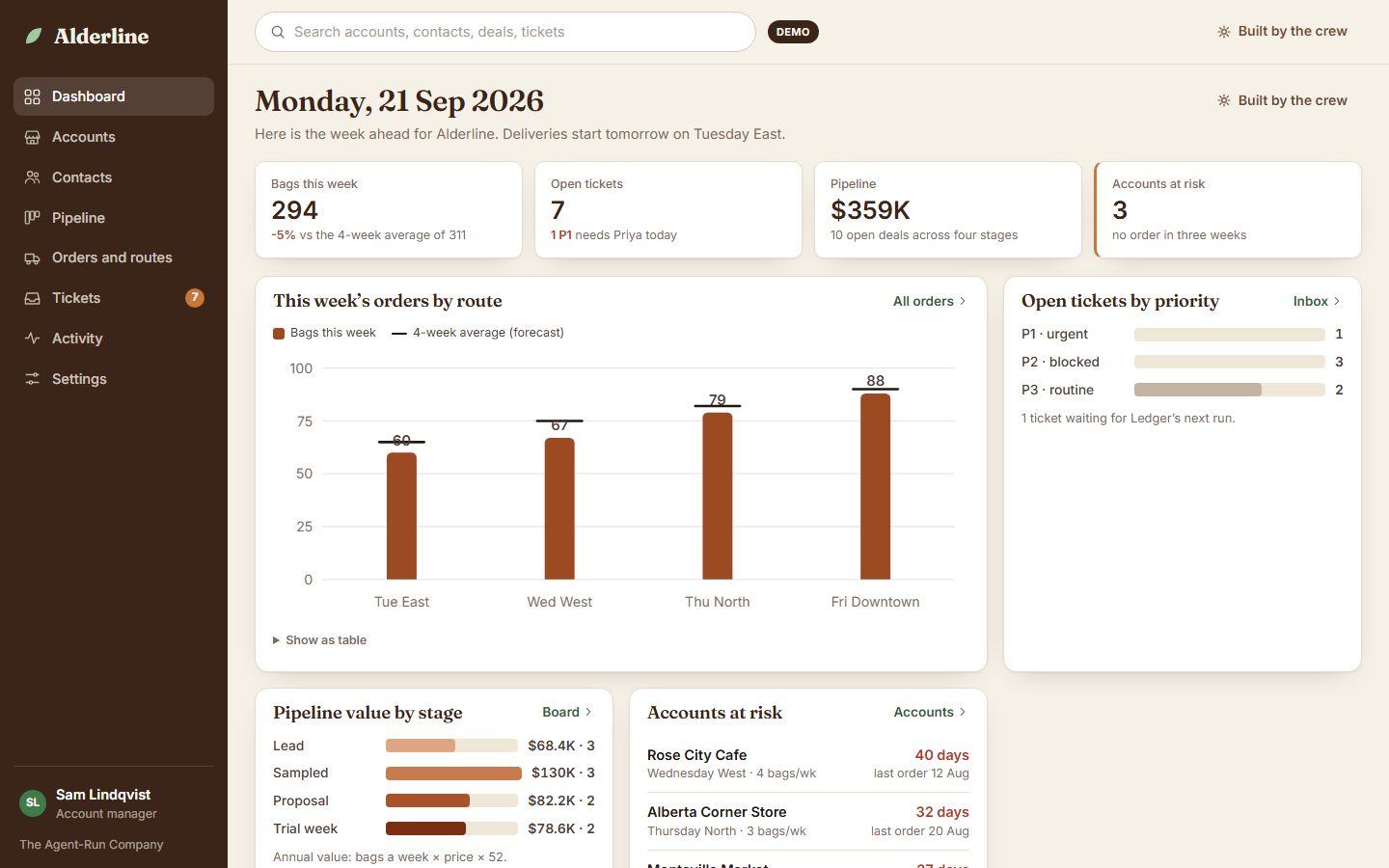
The demo CRM is what the crew built. Click around it as Sam would. Then open the dashboard and see what it cost in hours.
Chapter 1 installs and connects all of it. Budget an hour.
This pack assumes you know the foundations: how an agent remembers, how you write a policy it follows, how connectors work, how to think of agents as staff, and why work runs in a loop. Those are in the AI Workflows playbook. Read it first if any of those words are new. This pack starts where it ends.

Alderline's CRM as the crew built it. Accounts, routes, tickets, activity. Runs in your browser with invented data.
Open the CRM → ↻The lifecycleStep through the six stages with the real Alderline issues. See which agent owns each move and where the gates sit.
Open the lifecycle → ▤The dashboardTime working, work done, learning. Six weeks of crew telemetry from the build.
Open the dashboard → ▶The deckThe product flow as a forked deck. Built with the deckbuilder framework. Show it to a client.
Open the deck → ⚙The kitEvery file the chapters quote. Agent files, gates, hooks, connectors, Bellows and the kickoff prompts. Copy, do not retype.
Open the kit →No. You need both to run the pack as written. The crew is designed around two vendors so that Ember's code gets reviewed by something that did not write it. If you have only Claude you can run Flint's role as a second Claude Code agent with the same instruction file. You lose independent judgement and you keep the protocol. Chapter 4 shows how.
Yes. Start with Anvil. Give it your backlog and let it scope one request into acceptance criteria. That alone changes how you write tickets. Add Ember when you want the code. Add Flint when you want the code reviewed. Bellows comes last. Until then you are the dispatcher and you move the Linear states by hand.
Two subscriptions and a handful of free tiers. The subscriptions cover interactive use of Claude Code and Codex up to their limits. The cost that moves is agent run time. A quiet week where Bellows finds nothing to do costs close to nothing. A busy build week is tens of dollars in usage, not hundreds. What drives it: how many slices are in flight, how many review rounds they take, and how often Gauge has to rerun. The gates file caps runs per issue per day and minutes per run so a stuck loop cannot run up a bill. The dashboard shows hours by agent so you can see where the money goes.
Founders with some software instinct. You should know what a repo and a pull request are. You do not need to read TypeScript. Every chapter tells you what to paste and what you will see. The engineering happens inside the agents. Your job is the one Priya has: decide what to build, answer the gate questions, and read the paper trail.
Swap the brief. The crew does not care what it builds. The kit's agent files mention Alderline in their project section and nowhere else. Change CLAUDE.md and AGENTS.md to describe your product and your users. Keep the states, the gates and the protocol. The CRM is the worked example because a founder can judge whether a CRM is right without being an engineer.
A map of the company. Nine agents you can name and one founder at the gates. The loop every chapter follows and the picture of one request going round it. You know which two chapters to read first and where the demo lives when you want to see the result before the work.
Next: Chapter 1 · The workshop. Install Claude Code and Codex. Connect Linear, GitHub and Vercel. Copy the kit into a fresh repo and prove the guard hook fires before any agent touches anything.